AMLR and UBO mapping: how beneficial ownership identification changes in 2027
Download the Executive Summary slides (PDF)
This article is part of our AMLR 2027 series.
Key takeaways
From 10 July 2027, the Anti-Money Laundering Regulation changes how beneficial ownership is determined across the EU (Art. 51, Regulation EU 2024/1624). Ownership interest will be calculated using the accumulation method (Art. 52), and ownership through control has to be assessed alongside it (Art. 53).
In short, AMLR requires companies to:
1) Follow every ownership chain to the end, however small the holdings in between.
2) Multiply the ownership percentages down each chain.
3) Add up what each person holds across all the chains involving them, unless ownership and control mix within the same chain - there the combination rule takes over (see below).
4) Name anyone who reaches 25% or more as a beneficial owner, including a person holding exactly 25%.
5) Assess control too, not just ownership.For Nordic compliance teams, the big shift is in the usage of beneficial ownership registers. Under AMLR, the registers can no longer be used as a standalone verification source. You verify beneficial ownership through your own means first, then check the register (Recital 54).
Overall, ownership is only one of three checks AMLR requires. Control is assessed separately (Art. 53), and a combination rule (Art. 54) captures people who own at one level and control at another.
If no beneficial owner can be identified, AMLR requires identifying and verifying all of the company's senior managing officials, not just one (Art. 22, 63).
More named individuals per company means more identity verification, screening, and monitoring. A UBO process built to AMLR works only when there is a process ensuring that every identified person flows into screening and ongoing monitoring, running on the same customer record.
Introduction
A beneficial owner is the real person who ultimately owns or controls a company, even when that ownership runs through layers of other companies. AMLR changes how beneficial owners are identified across the EU (Art. 51).
The main change is how ownership is calculated, as AMLR introduces the accumulation method (Art. 52, Regulation EU 2024/1624). In this approach, ownership percentages are multiplied at each level of a corporate structure and added across every chain, compared against a threshold of 25% or more ownership. On top of that, control (Art. 53) has to be assessed separately, not only direct ownership.
The overall implication for compliance teams is that companies need to restructure the entire process of mapping company ownership, including where the information is coming from.
Many Nordic companies have been using national beneficial ownership registers as the primary source for confirming who owns a company, and under AMLR, these registers can no longer serve as a standalone verification source.
This article covers what these new rules do to the UBO mapping process itself: the three checks AMLR now requires, how many individuals you need to name, how to replace the register shortcut, and what to do when no beneficial owner can be found.
Note: This article reflects the AMLR regulation as enacted (Regulation EU 2024/1624) and guidance available to date. Some operational detail, including data requirements for intermediate entities and permitted verification methods, sits in technical standards that are still in draft. AMLA must submit its first draft regulatory technical standards to the European Commission by 10 July 2026; the Commission then adopts them.
What does AMLR change in UBO mapping?
In short: beneficial ownership will be assessed in three ways, not one. Most approaches used today identify beneficial owners only one way: trace the ownership chain to the majority owner at each level, and stop there.
AMLR requires three separate checks instead: ownership, control, and the combination of the two. A person flagged by any one of the three is a beneficial owner.
1 Ownership (Art. 52).
Ownership percentages are multiplied down each chain and totaled across all chains. You can't stop following a chain just because someone's share is small. The ownership threshold also moves from "more than 25%" to "25% or more," so a person holding exactly 25% now qualifies.
2 Control (Art. 53).
Control is assessed independently and in parallel with ownership, whether or not the person holds any equity. A person can be a beneficial owner through control alone. We'll go deeper into how exactly AMLR defines control shortly.
3 Combination (Art. 54).
This is a catch-all check for multi-level structures where a person holds ownership at one level and exercises control at another within the same chain. In those cases, this rule decides the outcome, not the ownership maths on its own.
Example:
A person controls a holding company (through board-appointment rights) that in turn holds a 30% ownership stake in the company you're onboarding.
-> Art. 54 ties the two together and names that person as a beneficial owner.
The practical point here is that a UBO process which only multiplies ownership chains will be incomplete against the new regulation. Control and Combination will name individuals that focusing on Ownership alone would never surface.
Example of ownership mapping with the accumulation method
Consider a company, Nordic AB, owned by two holding companies: HoldCo A & B.
HoldCo A owns 50% of Nordic AB.
HoldCo A is owned by Person 1 (45%) and Person 2 (55%).
HoldCo B owns 50% of Nordic AB.
HoldCo B is owned by Person 1 (45%) and Person 3 (55%).
Calculating each individual's accumulated ownership:
Person | Ownership via HoldCo A | Ownership via HoldCo B | Accumulated | Beneficial owner under AMLR? |
|---|---|---|---|---|
Person 1 | 22.5% (50% × 45%) | 22.5% (50% × 45%) | 45% | Yes |
Person 2 | 27.5% (50% × 55%) | — | 27.5% | Yes |
Person 3 | — | 27.5% (50% × 55%) | 27.5% | Yes |
Once the two chains are added together, Person 1 holds 45% and becomes the single largest beneficial owner of Nordic AB. If we were to assess each ownership chain against the threshold separately, Person 1 holds 22.5% in each chain, and falls below 25%.
This is the type of ownership the accumulation method helps map. The individual most likely to be missed under today's approach is, in this case, the company's largest owner.
Note that this example covers ownership only. Add the control or combination of ownership and control, and the amount of named individuals will be again higher.
What "Control" means under AMLR, in practice
Control is likely to be overlooked when mapping UBOs, because the people it identifies often hold little or no equity and would rarely appear in ownership registry data.
These are the types of control that make someone a beneficial owner under AMLR:
Majority voting rights, including voting pools and acting in concert
The right to appoint or remove the majority of the board, or the administrative, management, or supervisory body, or similar officers
Veto rights, profit rights, or asset-disposition rights
Softer forms of control, such as informal arrangements with shareholders, family relationships that create real influence, and nominee arrangements, require case-by-case judgement.
Most control does not show up in any register. To identify it, you need structured questions at onboarding that ask the company directly about voting agreements, appointment rights, and nominee arrangements.
A control assessment that relies only on register data will simply miss many of the individuals.
Examples of UBO mapping under AMLR.
Having to run three checks (ownership, control, combination) may sound abstract until you apply them to a real ownership structure. The examples below work through three cases of ownership structures to showcase who qualifies as a beneficial owner. They compare the method most companies use today (ownership-focused mapping) to what AMLR requires.
As you'll see, in each case, AMLR names people that the current approaches miss, and for a different reason each time.
Example 1: Ownership - Accumulation method
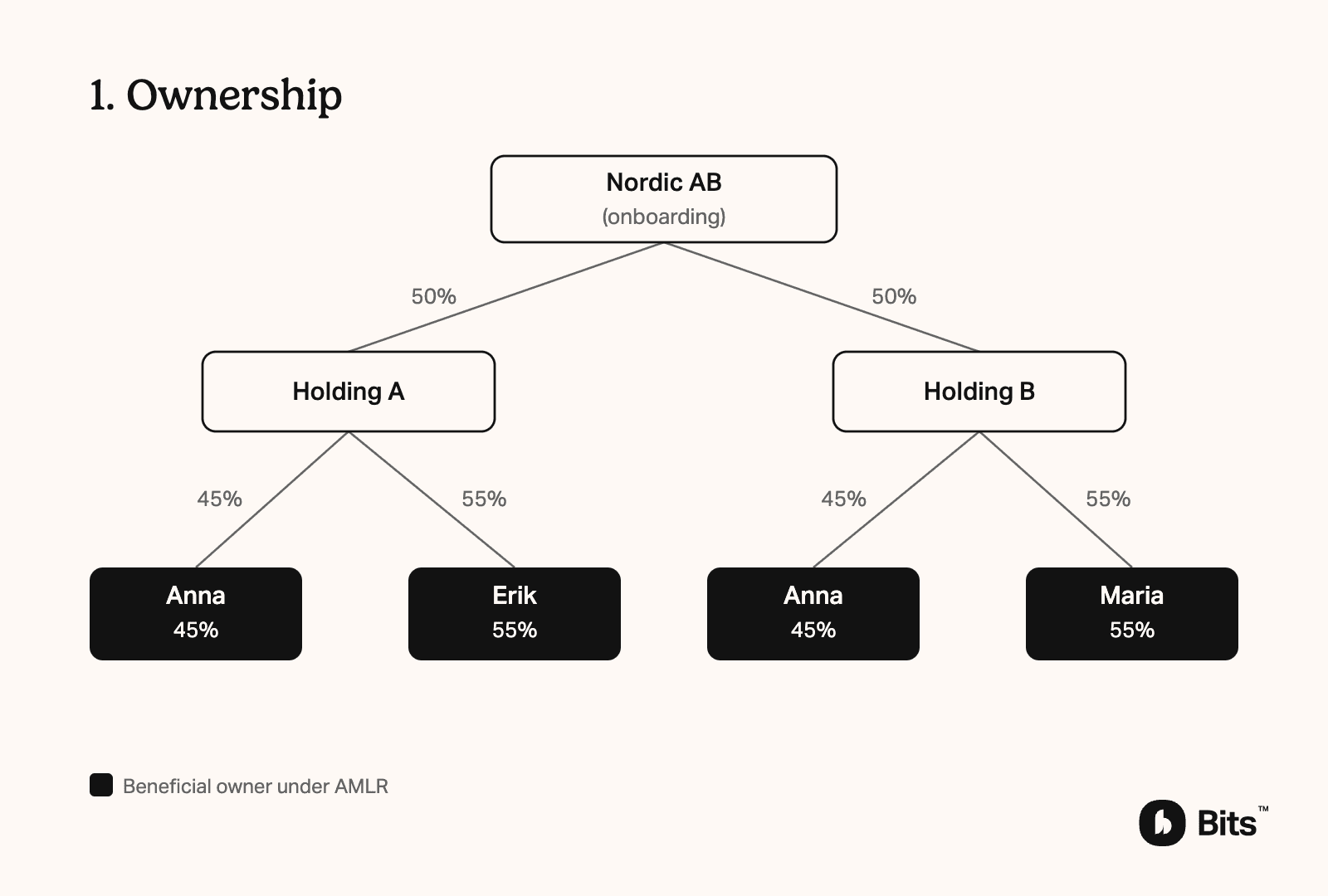
UBO mapping today, focus on ownership: Erik (27.5%) and Maria (27.5%) are the beneficial owners. Anna holds 22.5% through each holding company, which is below 25% in both, so she is not considered a beneficial owner.
UBO mapping under AMLR: Anna (45%), Erik (27.5%) and Maria (27.5%) are beneficial owners. Anna's two stakes are added together (22.5% + 22.5% = 45%), which through accumulation makes her the largest beneficial owner of Nordic AB.
Example 2: Control
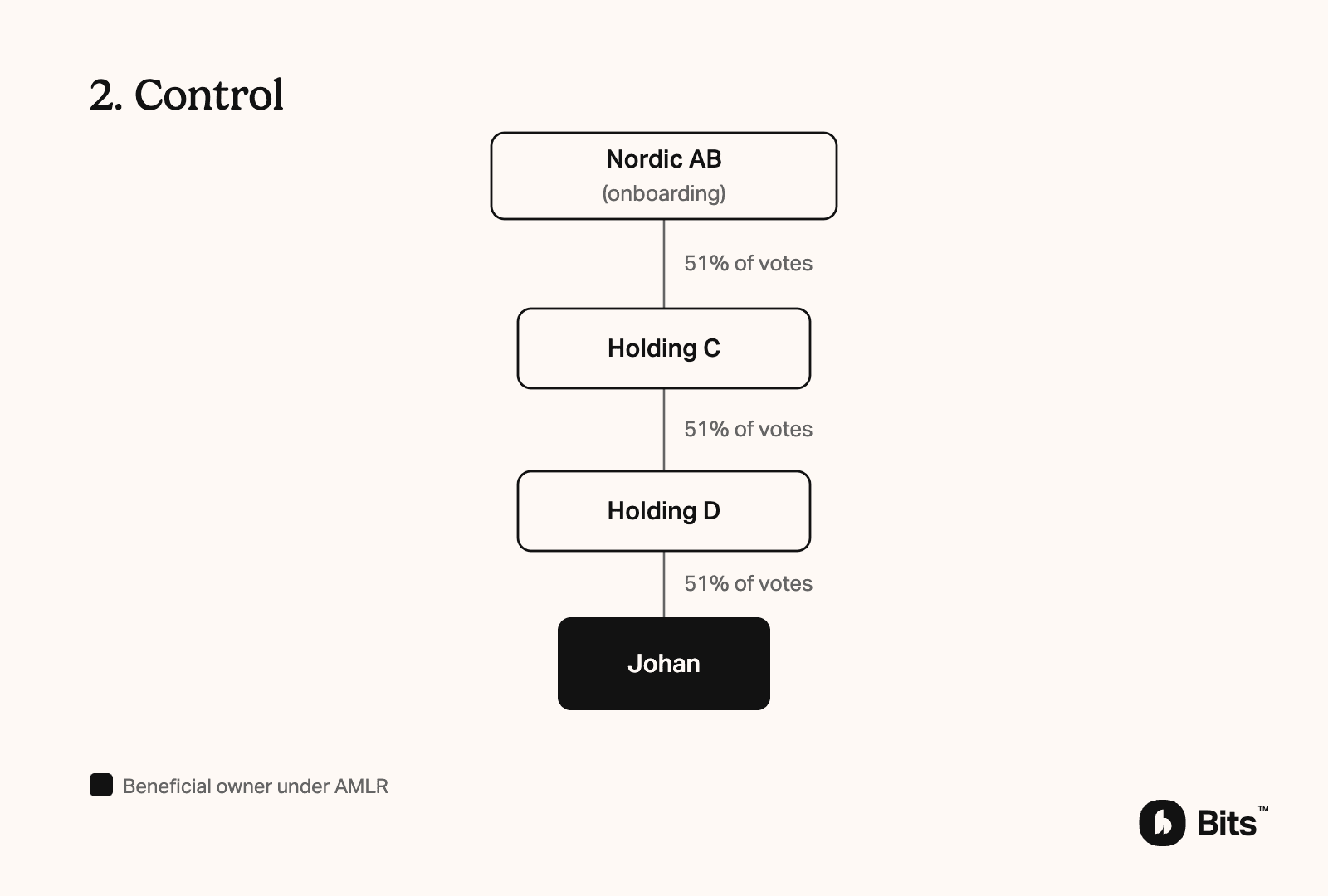
UBO mapping today, focus on ownership: Johan's ownership totals 13.27% (0.51 × 0.51 × 0.51), which is below the 25% threshold, hence he isn't considered a beneficial owner.
UBO mapping under AMLR: Johan actually holds a majority of the votes (51%) at every level, so he is a beneficial owner through control, even though his ownership of Nordic AB is below 25%.
Example 3: Combination
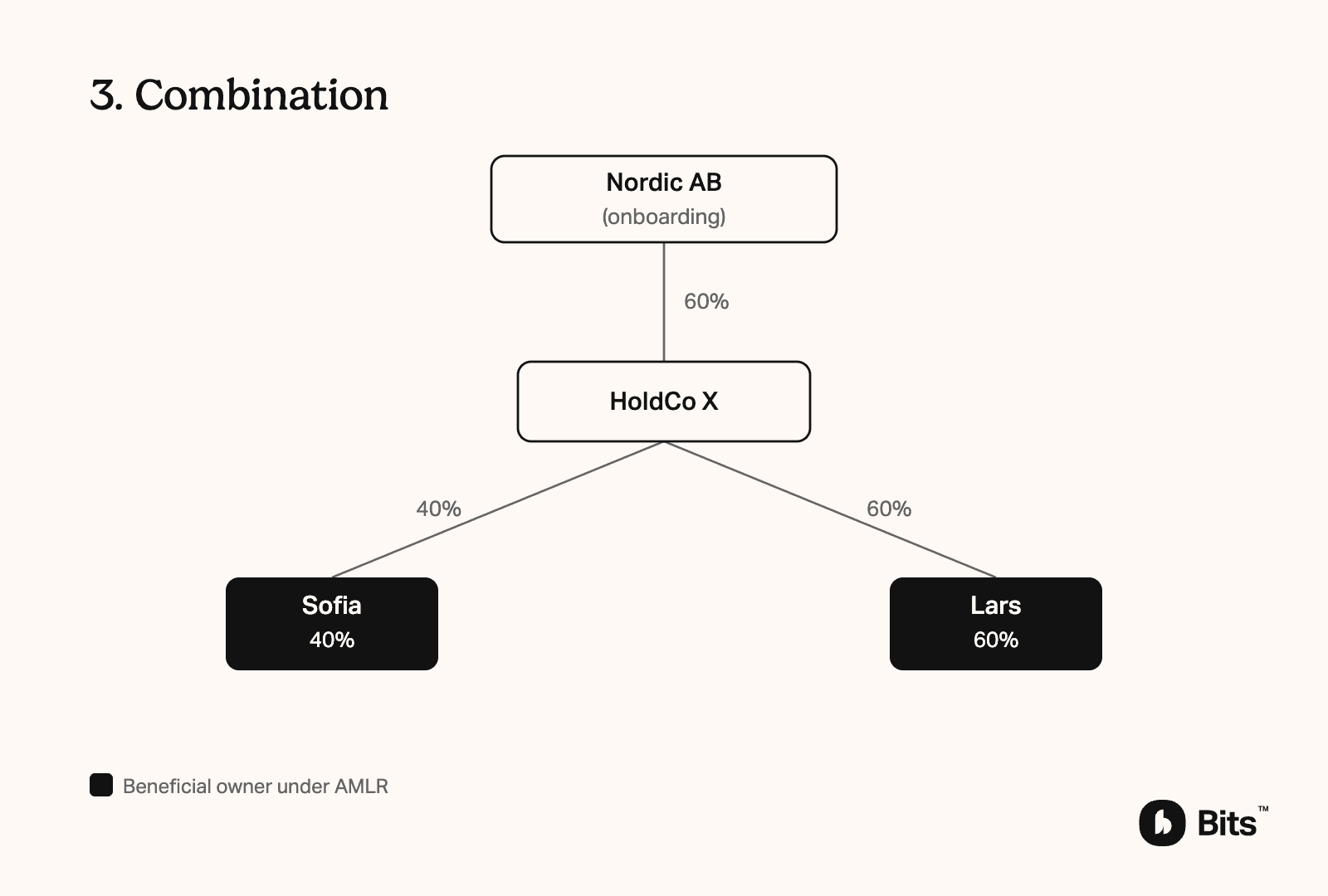
UBO mapping today, focus on ownership: Lars (60% x 60% = 36%) is a beneficial owner. Sofia's ownership (40% × 60% = 24%) is just below the current threshold, so she isn't.
UBO mapping under AMLR: Sofia and Lars are both beneficial owners. HoldCo X controls Nordic AB (it owns 60%), and Sofia owns 40% of HoldCo X. Under the combination rule (Art. 54), holding a 25% or more stake in a company that controls the target makes Sofia a beneficial owner, even though her indirect ownership of Nordic is just 24%.
What this means for compliance teams:
Any ownership calculation will be only as good as the structure behind it.
Before any of the checks can run (ownership, control, combination), the full ownership and control structure of the company needs to be mapped as an organisational chart. Every holding company or individual with capital or voting rights should be recorded. The new accumulation method won't work without it: you simply cannot multiply and add across chains you have not mapped.
For compliance teams that have relied on a register entry or a company-supplied summary, this shift means that the operational work will grow significantly.
Why the beneficial ownership register is no longer the answer
The beneficial ownership registers still have a role under AMLR: consulting the register remains a requirement. But relying on it as the verification step won't be enough.
In practice, it's the ownership mapping process that changes:
Today, a match between the company's declaration and the register is enough.
From July 2027, you need to determine and verify beneficial ownership through your own means first, then compare your result against the register.
To verify ownership, you should use verification methods you can stand behind: a document check, qualified electronic identification, or other reliable sources applied on a risk-proportionate basis with the reasoning recorded.
And if your findings differ from the register, you need to act on it.
AMLR requires you to report discrepancies between your own beneficial ownership findings and the central register within 14 calendar days of detection (Art. 24).
The regulation includes exceptions for typographical errors and outdated data where the real owner is known from another reliable source. However, this exception does not apply to higher-risk companies.
The new required approach favours working from original documents.
When your UBO result comes from registry filings, articles of association, and shareholder lists, you can show exactly how you reached it and defend it if a regulator asks. If it comes from a data provider whose method you can't see, you can't.
AMLR expects you to show how you got to the answer, so the original documents become the safer source.
What to do when no beneficial owner can be identified
If after trying all means of identification, no beneficial owner can be found, AMLR requires you to identify all senior managing officials and verify their identity (Art. 22). This replaces the common practice of recording a single senior manager as a stand-in.
Senior managing officials are defined as the executive members of the management body and the persons responsible for the day-to-day management of the entity (Art. 63). For a company with a large management body, that can mean several identity checks and screening runs where today there is one.
There's one exception. If verifying the officials' identity would tip off the company that you have doubts about who its real owners are, don't verify; identify them, and record the steps you took instead.
General implications for compliance teams
Each UBO mapping change that AMLR introduces points the same way: there will be more named individuals per company.
The control and combination checks add individuals that the old way would miss. And where no beneficial owner is found, the fallback expands from one senior manager to all of them.
Every beneficial owner named adds the same downstream work: identity verification, screening against PEP and sanctions lists, and a place in the ongoing monitoring queue. For teams running UBO checks manually or across separate tools, the increased volume compounds the work across the whole portfolio.
What's worth noting is that all this additional work will be hard to execute unless the data flows seamlessly from one system to another.
A UBO graph that sits in one tool, screening in another, and ongoing monitoring in a third adds a significant amount of manual checks, and leaves the result hard to reconstruct when a regulator asks.
This aligns with the connected-data expectation that runs in the background of AMLR as a whole.
Preparing for AMLR means building a data infrastructure where onboarding, monitoring, and case management operate on the same customer record. Additional read: Why AMLR 2027 is a data architecture problem.
A UBO mapping checklist for AMLR for compliance teams
Map the whole structure first. Every owner and holding company, every level, with ownership and voting rights noted separately. You can't calculate across chains you haven't mapped first.
Run all three checks. Ownership by the accumulation method at 25% or more (Art. 52), control on its own (Art. 53), and the combination rule where someone owns at one level and controls at another (Art. 54).
Ask about control at onboarding. Add direct questions about voting agreements, appointment rights, and nominee arrangements.
Verify it yourself, then check the register. Work out beneficial ownership through your own means, compare it against the register, and report any difference within 14 calendar days (Art. 22, 24).
No owner found? Name every senior manager. Identify and verify all senior managing officials, not one stand-in (Art. 22, 63).
Connect each named person to the same record. Beneficial owners flow into PEP and sanctions screening and ongoing monitoring; everyone you name stays on the same company record and stays current if the structure changes.
FAQ
How does UBO identification change under AMLR 2027?
AMLR replaces the different national methods with three checks you run on every company (Art. 51): ownership (Art. 52), control (Art. 53), and a combination of the two (Art. 54). A person caught by any one of them is a beneficial owner. The usual result is more named beneficial owners per company than today.
What is the AMLR accumulation method?
It's the way AMLR makes you calculate ownership-based beneficial ownership (Art. 52). You follow every ownership chain, multiply the percentages down each one, and add up what each person holds across all chains. Anyone who reaches 25% or more is a beneficial owner. Someone whose stake is split across several chains, and who looks small in each one, can still cross 25% once you add them together.
Does the accumulation method identify more beneficial owners?
Usually, yes. Adding stakes across chains catches people who sit below 25% in any single chain, and the control and combination checks catch people that ownership math misses entirely. Every extra person named means more identity verification, screening, and monitoring.
What is the UBO threshold under AMLR?
25% or more (Art. 52). Today, it's usually "more than 25%". The wording change is small on its own, but it means a person holding exactly 25% now counts. Combined with the accumulation method, more people cross the line.
Can I still rely on the beneficial ownership register under AMLR?
Not on its own. You still have to consult the register, but it can no longer be your verification step. You work out beneficial ownership yourself, compare it against the register, and report any difference within 14 calendar days (Art. 24). For Nordic teams used to treating the register as the answer, this means calculating beneficial ownership independently for every company.
How is control assessed for beneficial ownership under AMLR?
Control is assessed alongside ownership, not instead of it (Art. 53). Some forms make someone a beneficial owner automatically: majority voting rights, the right to appoint or remove most of the board or management or supervisory body, or veto, profit, or asset rights. Softer forms, like family ties or nominee arrangements, are a documented judgement call. Someone can be a beneficial owner through control with little or no ownership.
What is the difference between ownership and control under AMLR?
Ownership is about how much of a company a person holds: shares, voting rights, or other interests, calculated by the accumulation method and counted at 25% or more (Art. 52). Control is about influence regardless of how much someone owns: a majority of votes, the right to appoint or remove the board, management or supervisory body, veto or profit rights, or arrangements such as nominees (Art. 53). AMLR requires both to be assessed in parallel, so a person can be a beneficial owner through either route, or both.
What happens under AMLR when no beneficial owner can be identified?
If you've exhausted every means and still can't identify one, you identify and verify all the senior managing officials instead, not just one (Art. 22). These are the executive members of the management body and the people running day-to-day operations (Art. 63).
What are senior managing officials under AMLR?
Senior managing officials are the executive members of a company's management body and the people responsible for its day-to-day management (Art. 63). They matter under AMLR because, where a company has no identifiable beneficial owner after all means are exhausted, you must identify and verify all of them, not just one (Art. 22).
If you're assessing how AMLR, the accumulation method and the new control checks change your UBO process, we're happy to walk you through how to approach it.
—
More in the AMLR 2027 series
—
Published: 16 June, 2026
This article is published by Bits Technology, a compliance infrastructure platform for regulated financial companies in Europe.